Tuesday, April 12, 2011

Kitler's Work Features in The Artist's Magazine


Society of Animal Artists member David N. Kitler and his work are being showcased in a feature article in the April 2011 issue of The Artist's Magazine, on newsstands now.  The multiple-page spread includes several of David's latest pieces - with an emphasis on David's quest for uniqueness and originality in his work - along with a step-by-step demo on acrylics techniques.

With a circulation of over 140,000 copies, The Artist’s Magazine is the world’s leading magazine for artists. It focuses on spotlighting the processes of the best artists working today, while keeping readers abreast of professional practices that can help advance their own careers.  A regular contributor in the "Drawing Board" column, David has also won First Place in the magazine’s prestigious Annual Competition (Animal/Wildlife category), and was later honored to serve as its Juror.

Visit www.artistsmagazine.com to check out the extra online materials:


- Masking with Cellophane:    

- Perceiving Transparent and Opaque Colors:

(rc)

Wednesday, March 2, 2011

Diane Mason featured artist at NatureWorks


Congratulations to Society of Animal Artists member and president Diane Mason, she will be the featured artist at this year’s NatureWorks Art Show & Sale in Tulsa, Oklahoma. 

March 5th and 6th, 2011
RENAISSANCE Tulsa Hotel & Convention Center
Tulsa, Oklahoma


Diane has been a proud member of the SAA since 2003, and she has served on the Executive Board since 2005, becoming President in November of 2008. She has received the Leonard J. Meiselman Award for a Representational Sculpture in the Academic Manner in 2003, and an Award of Excellence in 2010 for her service as President.
“The Award of Excellence was the most appreciated and valued award of recognition that I could ever imagine receiving. This organization is very, very special to me – as are all of the artists in it.”
-Diane Mason
(rc)

Monday, February 28, 2011

SOME THOUGHTS ON APPLYING FOR MEMBERSHIP IN THE SOCIETY OF ANIMAL ARTISTS By Susan Fox, SAA

The deadline for the next round of consideration is coming up in mid-April. I thought that, having participated in three membership juries now as a member of the Executive Board of the Society, I would offer some observations and tips that might be helpful to those of you who aspire to membership in the SAA.

A couple of notes before we start- First, I’m a painter and that’s what I know best. What I’m going to say applies to most other media, but creating a successful painting will be my main focus. Second, this article represents my personal views and is not an official statement by the SAA, any of its officers or the other board members. If you have any comments or questions, please direct them to me.

Now, to begin: I recommend that you do this exercise. Go to the Society’s website, visit the virtual museum and the individual websites of any member’s work that catches your eye. Then get out at least eight or ten of your own pieces. Line them up. Look at them objectively. This is not easy. We tend to be either too hard or too easy on ourselves. Do your best to be honest since that is when opportunities for growth happen.

Representational painting in general, and animal art in particular, have well-established criteria for what constitutes a “good” painting. These principles have evolved over a number of centuries. They are not “subjective”.

You are not in competition for a limited number of spots as would be true with a juried show. We usually have between two and three dozen applications to consider. We can accept all of them. Or none of them. Each applicant’s work is judged on its own merits.

Pick one piece that you honestly believe is at or is close to the level of the work of the artists who are already members.

You now need four more at or near that level, because one of the things that will sink an application fast is one or two good pieces followed by the jury seeing the next three or four go off the cliff. You will be judged by your weakest pieces. Consistency is very important.

Consistent in what? Glad you asked...

1. DRAWING: Animals have a physiological and behavioral reality that a competent animal artist has to understand and demonstrate to the jury. In other words, you need to be able to draw them with accuracy and understanding if you are a traditional representational artist and clear understanding if you are going to handle them in a more personally expressive way. You are hoping to join the ranks of animal artists who have been doing this, in some cases, for decades. They know if the drawing is correct or not. Which way a leg can bend, how a wing moves in flight or what the pattern of spots are on a leopard are not really subject to debate, however open they are to informed interpretation.

2. CRAFT: We want to see a solid understanding of your chosen media, whatever it is. If you decide to submit work in more than one media, then all of them need to be at an equal level of competence. Don't submit a little of this and a little of that, hoping that something will stick, like spaghetti on a wall.

3. DESIGN AND COMPOSITION: Do you have a solid grasp of design and composition? Have you made a conscious decision about every element of your piece? For instance, are the subjects in the majority of your submissions plopped automatically into the middle of the canvas or thoughtfully placed to carry out your central idea?

4. PERSONAL VISION: Are you creating art based on a personal vision or simply copying photographs? (It is well-known that photographic images flatten and distort three-dimensional subjects like animals, so the artist must learn how to compensate for that if their goal is a realistic representation.) What do YOU have to say about lions and elk, butterflies and buzzards? Let your opinion, point of view and passion come through. HAVE an opinion, point of view and passion about your subjects.

5. KNOWLEDGE: Do you understand basic animal anatomy? Do you understand the habitat of the species you are representing? Have you learned about their behavior as an inspiration for your work? Or is everyone just standing around? If you put an animal in a realistic setting, you are now a landscape painter too. Are both your animals and any habitat shown depicted at the same level? Or does one lag behind the other?

Animals are specialized subject matter that require study and the accumulation of knowledge over time to represent successfully. There are no shortcuts.

We are looking for artists who have mastered their art and craft at a consistent level and who present us with a body of five works which all reflect that level.

Good luck!

Monday, February 21, 2011

James Coe is Woodson's 2011 Master artist!

 James Coe selected as the
Leigh Yawkey Woodson Art Museum's 32nd Master artist

James Coe

We are proud to announce that Society of Animal Artists Signature Member James Coe has been selected as the Leigh Yawkey Woodson Art Museum’s 2011 Master Artist and will be honored during the Museum’s 36th annual Birds in Art this fall. James has been a member of SAA since 2003 and has served on the Executive Board since 2009. An award-winning artist, he received the Hiram Blavelt Purchase Award in 2006, the Award of Excellence in 2008 and the “Western Art Collector” award in 2010.

James Coe, Last Light, Potic Creek, 2007, Oil on Belgian linen
“Jim Coe is an outstanding painter that goes beyond capturing the essence of wild fowl and landscapes. With his painterly style, he creates a mood and a genuine atmosphere. Jim is ‘an artist’s artist’.  He is invaluable on the SAA Executive Board, as he never fails to bring a thoughtful and intellectual presence to the meetings, and I value his wise counsel on various issues. His contribution to promoting the concept of excellence in the genre of animal art is significant, and he is the ideal selection for this year’s Master Artist at the Leigh Yawkey Woodson’s Birds in Art Exhibition.”  – Diane Mason, President Society of Animal Artists

James Coe, Mill Pond Geese, 2006, Oil on Belgian linen

As the Woodson’s 32nd Master Artist, Coe’s work reflects a synthesis of two styles, weaving his insight and skill as a trained naturalist into fresh, deftly painted landscapes. Coe first became enamored with egrets and shorebirds that flocked to salt marshes near his suburban New York City boyhood home. After working for years as a field guide illustrator, he ventured into the art world and began painting landscapes en plein air.

For more information, check out the official announcement from Leigh Yawkey Woodson Art Museum.

(rc)


Monday, January 24, 2011

WAJ's Gallery of the Commons


Greetings everyone,

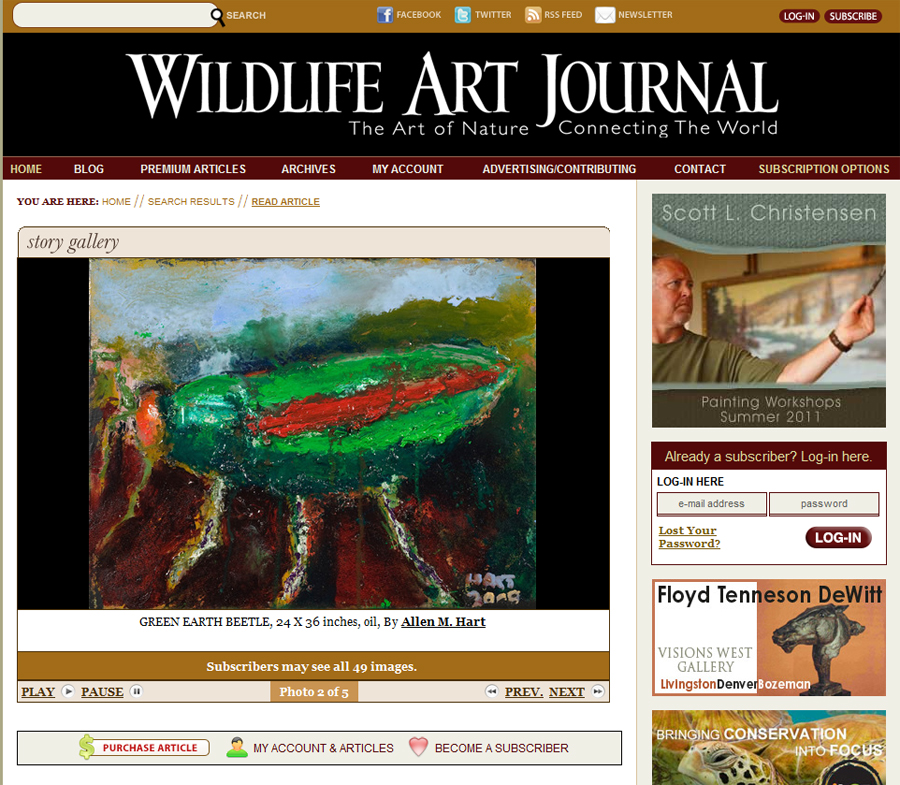
Wildlife Art Journal is again accepting images from painters, sculptors and photographers to appear in its next "Gallery of the Commons" the end of January.  What does WAJ mean by "wildlife art"? Any artistic portrayal of wildlife in a natural or urban environment, in any style. We do not hold to a narrow definition.  See Simon Gudgeon's definition in the latest SAA newsletter. 

If you are interested, please send a jpg image of your work, along with title, dimensions, and medium to: editor@wildlifeartjournal.com It's a great way for other artists and collectors to see your work. Please also include your web address. We'll provide a hotlink back to your site.  


(rc)