Tuesday, November 21, 2017

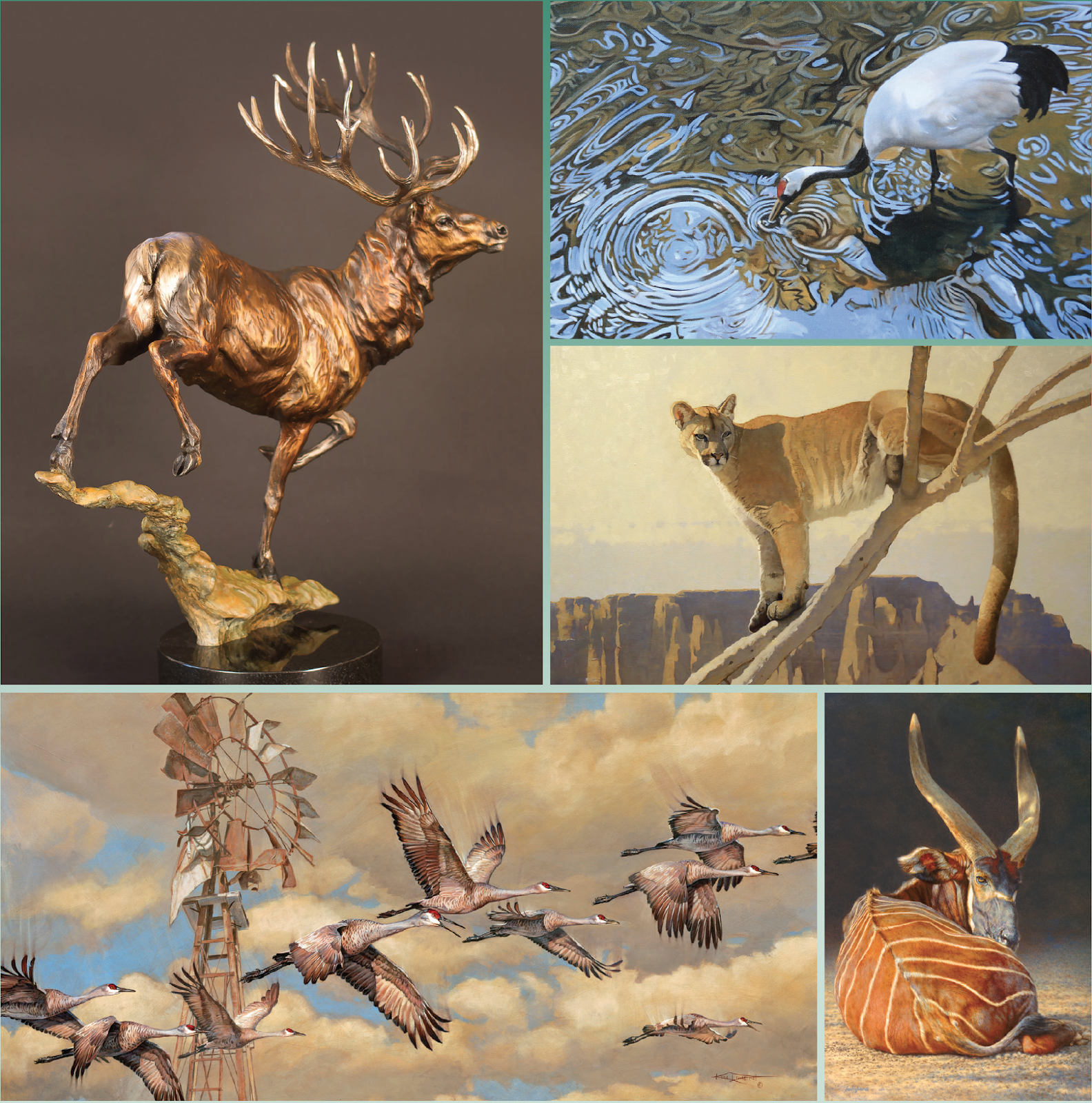
57th SAA Tour at the National Mississippi River Museum & Aquarium


      ART AND THE ANIMAL

The 57th Annual members' show of the Society of Animal Artists 
is now open:


November 18, 2017 - January 7, 2018
Dubuque, IA


David J. Wagner, L.L.C.
Member/President
by David J. Wagner, Ph.D.
Curator/Tour Director
Office Phone: (414) 221-6878

Tuesday, September 19, 2017


Brian Jarvi’s AFRICAN MENAGERIE is a traveling museum exhibition of epic scale, 15 years in the making.  The centerpiece of the exhibition was unveiled for a preview on September 16, 2017 at The Reif Center for the Performing Arts, in Grand Rapids, MN, near the artist's home and studio.  Over 800 people attended the standing-room-only event.

Click here for a video interview with Brian Jarvi:  https://storyboardfilmsmn.wistia.com/medias/66yk27okbu


The centerpiece of Brian Jarvi’s AFRICAN MENAGERIE is comprised of seven interlocking panels, housed in rich walnut cabinetry that form a sweeping, grand panorama 32 feet wide by 14 feet high, depicting the African savannah and the animal kingdom contained therein. Over fifty related research sketches and mixed media studies (approximately half of the artist's output for the project), many of them large, surround the panorama.


Brian Jarvi, who is an award-winning member of The Society of Animal Artists, is widely recognized among the very best painters of African wildlife today.  His concept for ”African  Menagerie" was spawned from early childhood memories and fascination with both living collections  of  wild  animals, and paintings from the  distant  past  portraying  large  varied  groups  of exotic creatures.  In  his  "Menagerie,"  the  gathering  of  an incredible   array  of  wildlife  is  set against  a  grand  panoramic  backdrop  of  the  receding  snows  atop  Mount Kilimanjaro.  All of Africa's icons including the Elephant,  Leopard, Giraffe, Rhino, Hippo, and Zebra mingle  with  such  exotics  as  Bongo,  Okapie,  and  Mandrill, which gaze directly at viewers, in a way that reveals the artist's subtext for the exhibit, namely an Inquisition of Homo sapiens and the plight of threatened and endangered wildlife species.


The project’s storyline was calculatingly intended to dramatize the urgency of the moment to save not  just  the  great  iconic  species  of  Africa,  but  also wildlife  across  all of our shrinkingly, diverse, environmentally-threatened planet.

In  preparation  for  the  creation  of  "African  Menagerie,"  Jarvi created more  than  100  studies  in pencil,  charcoal,  monochromatic  oils,  mixed  media  as well as  major  full-color  oils  of a  multitude  of  species, six of  which  have  been  juried  into  major  exhibitions  including  The  Annual Exhibition of the Annual Exhibition of the prestigious Society of AnimalArtists. 


Documenting the project will be a coffee-table book by Todd Wilkinson, author of such books as Last Stand: Ted Turner's Quest to Save a Troubled Planet, and Kent Ullberg: Monuments to Nature. The book is pending publication by Rizzoli Publications, New York.
The complete exhibition of AFRICAN MENAGERIE is scheduled to premiere at The Sternberg Museum of Natural History, Fort Hays State University, KS from October 1 to December 21, 2017; and tour from  January 20 to April 5, 2018 at the Hiram Blauvelt Art Museum, Oradell, NJ in the New York City Metropolitan area; and from April 26 to July 15, 2018 to Canton Museum of Art, Canton, OH. Additional Venues are pending. 


Photography Credit: Steven M. Tiggemann, TiggCreative
All Works 2017 © Brian Jarvi
Tour Produced by David J. Wagner, L.L.C.

Sunday, June 11, 2017


ART AND THE ANIMAL

On Display June 3 - September 3, 2017
(about an hour and one-half by car West of Washington, D.C.)

Photos Courtesy of: Anita Baarnes


Greetings SAA Members!

The Museum of the Shenandoah Valley (MSV) is excited to announce we are gearing up for tomorrow’s opening of Art and the Animal! The MSV is the final stop on the exhibition’s 2016–17 tour. For more about the exhibition’s display at the MSV, see the media release HERE.

Art and the Animal will be on view in the MSV Changing Exhibitions Gallery from June 3 through September 3, 2017. We would love to have you visit as our guest and see the MSV installation of Art and the Animal. Please introduce yourself as one of the exhibition’s artists at the front desk and your admission to the MSV will be on the house.

Just minutes from I-81 (901 Amherst St, Winchester, VA), the MSV includes galleries, seven acres of gardens, and the Glen Burnie House. The MSV is open Tuesday through Sunday from 10 a.m. until 5 p.m. On Wednesdays through August 30, extended summer hours until 8 p.m. are in effect (thanks to corporate underwriting MSV admission is free to all every Wednesday).

We hope to see you at the MSV!

Sincerely,
Nancy Huth
MSV Deputy Director, Arts & Education

Above: MSV Director of Exhibitions Corwyn Garman installs Brute Force, a sculpture of an African black rhino by Mick Doellinger, SAA (Fort Worth, Texas). Photo by Rick Foster.


Monday, April 10, 2017

ARTHUR SINGER: THE WILDLIFE ART OF AN AMERICAN MASTER


"I first read Birds of the World illustrated by Arthur Singer at age 8 in Sri Lanka. I saved my pocket money for one year to purchase it, it was my very first bird book. It so inspired me and directly affected my attention to details and devotion to ornithological art."

Gamini Ratnavira
Artist, Illustrator and Naturalist 


ARTHUR SINGER: THE WILDLIFE ART OF AN AMERICAN MASTER


Authors: Sons, Paul Singer, Alan Singer
Layout and Design: Paul Singer
Introduction, David J. Wagner, Ph.D.
Publisher, Rochester Institute of Technology Press
Release Date: Late May/Early June

 Introduction Excerpt

I am old enough to have professionally known Arthur Singer during his lifetime, and, though that was long ago, young enough to still remember him. I first met Arthur Singer in 1977, when he attended the opening reception of the exhibition that would become known as Birds in Art.  At the time, Arthur was 60, I was 25.  Today, I remember Arthur Singer as an artist whose strongest works displayed the subtlest of tonalities and a beauty of patterned repetition, and as an artist situated squarely in mid-twentieth-century aesthetics, enterprise, and ideology when it comes to the art of natural history.

Arthur Singer (1917-1990) enrolled at the Cooper Union Art School in 1935 and graduated in 1939.  Singer remained in art school through the Depression, only to have World War II stymie his career… but only briefly and in a way that contributed to his artistic development: in the army he spent 3½ years designing camouflage for tanks, trucks, and other field equipment for the military campaign in North Africa.1

After the war, Arthur Singer returned to New York to work as an art director in a commercial advertising firm where he’d worked after graduation before the war, and briefly to Cooper Union to teach. In the early 1950s, he started doing free-lance work, including illustrations for nature articles in Sports Illustrated. His first big break in bird illustration came when World Book approached him after bird artist, Don Eckelberry turned down an assignment due to competing commitments to update its section on ornithology in the encyclopedia. This led to a commission to illustrate Birds of the World, published by Golden Books that came out in 1961 and sold in the hundreds of thousands. A bibliography of other books illustrated by Arthur Singer followed including Birds of North America published by Golden (the first real challenge to the Peterson field guide), as well as others including Birds of Europe published by Hamlyn in 1968, all of which drove Arthur to work twelve- to thirteen-hour days to produce countless illustrations through the turbulent sixties and into the 1970s.


Like Louis Agassiz Fuertes (1874-1927), Roger Tory Peterson (1908-1996), and others at the top end of the century’s bird artist hierarchy, Arthur Singer provided content to a burgeoning publishing industry hungry for quality illustrations for a print culture booming with commodities such as magazines, a range of books from tiny scientific field guides to large juvenile picture books and encyclopedias, and collector prints, stamps, and plates.2

Arthur Singer’s illustrations contributed immensely to public education and enjoyment of the natural world at a time when the environmental movement would reach its zenith. His concern for the environment was both shaped and fulfilled by public and private conservation initiatives, not the least of which was major legislation such as the Endangered Species Act.

pages from "Arthur Singer: The Wildlife Art of an American Master
Because Arthur Singer’s art differed from that of predecessors like Fuertes and Peterson, and from many of those in the next generation, he was able to distinguish himself as an individual artist with a signature style.  Whereas as the crop of younger artists coming out of commercial illustration were practicing a new, photo-realist (some would say feather-counting) aesthetic, Singer took a more classical, old-school approach, relying instead on a palette of muted colors and soft, fluid brushwork, but still imbued his work with a modern sense of design.  As one art critic wrote, “His subtle instinctive often mute color harmonies are unmistakable. But one is uniquely conscious of an overall design in his carefully thought out compositions—a dead giveaway of his early graphic design experience.”3

When asked if he worked differently when painting on assignment versus for the fun of it, Arthur answered, “On an assignment, I may make many careful progressive drawings before arriving at the final concept. But my watercolor landscapes may have no wildlife in the scene, and I enjoy the luxury and risk of the happy accidents that are the special delight of that medium.”4

pages from "Arthur Singer: The Wildlife Art of an American Master
My personal feeling about the easel paintings that Arthur Singer submitted for museum exhibitions is that they gave the impression of ease, much like a great performance by a virtuoso musician who makes his or her technique look easy to the point of being imperceptible compared to the beauty of the moment.5  I think it is fair to say the same thing about the art of Arthur Singer. 

David J. Wagner, Ph.D.  
Author, American Wildlife Art
Chief Curator, David J. Wagner, L.L.C.
Tour Director, Society of Animal Artists

Endnotes

1 Abbott Thayer (1849–1921), mentor of Louis Agassiz Fuertes, literally invented camouflage art in service of World War I.
2 David J. Wagner, “SLEWAPS: Signed Limited Edition Wildlife Art Photolithographs” (Ph.D. Dissertation, University of Minnesota, Minneapolis, published by University Microfilms International Dissertation Information Service, 1999).
3George Magnan, “Arthur Singer: In the Path of Audubon,” Today’s Art and Graphics 29, no. 8, (August 1981).
4Ibid.
5A metaphor that I believe Arthur Singer would have appreciated, since he was a real jazz aficionado.

Friday, March 17, 2017

L’art et l’Animal


 Photographies d’artistes: Jocelyn Russell, Debbie Stevens, John Baumlin, Brian Jarvi, Kim Diment.


 L’art et l’Animal 

L’Art et L’Animal est l’exposition phare de La Société des Artistes Animaliers et a été présentée dans plus de 50 lieux au cours des 50 dernières années, y compris des musées, des zoos et des centres d’art, culturels et scientifiques aux États-Unis et au Canada. 

POUR INFORMATION, CONTACTEZ: 414-221-6878; Davidjwagnerllc@yahoo.com ou visitez davidjwagnerllc.com 

Membre de l’Alliance Américaine des Musées et du Conseil International des Musées


La Société des Artistes Animaliers 

La Société des Artistes Animaliers est considérée dans le monde entier comme l’association d’artistes la plus prestigieuse consacrée au thème des animaux dans l’art. La Société des Artistes Animaliers a été fondée en 1960. Son siège social est situé dans l’historique Salmagundi Art Club sur la Cinquième Avenue à New York. Les membres de la Société viennent d’Afrique, d’Asie, d’Australie, d’Europe, d’Amérique du Nord et d’Amérique du Sud. 

La mission de la Société des Artistes Animaliers est de promouvoir l’excellence dans la représentation des animaux, domestiques ou sauvages, dans l’art. Au cours des 50 dernières années, les oeuvres créées par les membres de la Société des Artistes Animaliers ont établi de nouveaux standards d’excellence artistique dans les Beaux-arts. 

L’Art et l’Animal 

L’Art et l’Animal est l’exposition phare de La Société des Artistes Animaliers. L’Art et l’Animal se réfère à la fois à l’exposition annuelle de la Société des Artistes Animaliers, et à la tournée de l’exposition itinérante qui est générée à partir de l’exposition annuelle. Le réputé expert en Art sur la faune et auteur de l’Art Américain sur la Faune sauvage, Dr. David J. Wagner, sert en tant que directeur de tournée pour l’Art et l’Animal. En tant que tel, il est responsable de l’organisation annuelle des expositions, de la tournée et de la gestion de l’exposition itinérante. L’Art et l’Animal a été présentée dans plus de 50 lieux, dont des musées, des zoos et des centres d’art, culturels et scientifiques en Amérique du Nord au cours des 50 dernières années. Seul le meilleur de l’art animalier est sélectionné pour l’Art et l’Animal. Par conséquent, il est extrêmement difficile, et donc prestigieux, pour les artistes d’avoir leur travail artistique accepté dans l’exposition. 

Associant l’histoire naturelle et les beaux-arts de manière créative, les membres de la SAA concourent pour que leur travail soit inclus dans les expositions annuelles choisies par un jury composé de membres de la SAA qui se réunissent au Salmagundi Club à New York chaque printemps. En outre, un jury décernant les récompenses, composé d’experts distingués avec les qualifications les plus importantes possibles qui ne sont pas membres de la SAA, est chargé, avec la difficile tâche, d’examiner les expositions annuelles dans le but de reconnaître les plus hautes réalisations et de décerner des prix aux artistes respectifs. Les artistes qui ont remporté cinq prix ou plus se voient attribuer le statut spécial de “Membre avec une signature de Maître,” ce qui les exonère de passer par les futures sélections du jury et leur travail figure automatiquement dans les Expositions annuelles. Parmi les artistes actuels et actifs, on peut citer: Charles Allmond, Chris Bacon, Gerald Balciar, Robert Bateman, Burt Brent, Carel P. Brest van Kempen, Guy Coheleach, Walter Matia, Léo E. Osborne, Sherry Salari Sander, Kent Ullberg et Sue Westin. 

La première de l’Exposition annuelle et la tournée 

L’exposition annuelle de la Société des Artistes Animaliers contient généralement plus de 120 oeuvres de peintures, dessins et sculptures. L’exposition itinérante l’Art et l’Animal est composée d’environ 45 peintures et dessins et de 15 sculptures. Chaque automne, une toute nouvelle exposition l’Art et l’Animal est choisie dans l’exposition annuelle pour représenter la SAA en tournée. Les sites de la tournée comprennent généralement un mélange à parts égales d’institutions artistiques et d’histoire naturelle. Par exemple, après sa première à l’Institut d’Histoire Naturelle Roger Tory Peterson à Jamestown, NY, l’Itinéraire de la tournée 2005-2006 comprenait le Musée d’Art Hiram Blauvelt à Oradell, dans la grande région métropolitaine de New York; Le musée du désert de Sonora Arizona à Tucson, AZ; et le musée d’art de Canton dans l’Ohio. En Septembre 2010, le zoo de San Diego a organisé une Journée spéciale de la Société des Artistes Animaliers en conjonction avec la première de l’exposition annuelle du 50e anniversaire au Muséum d’Histoire Naturelle de San Diego. L’exposition annuelle de 2016 a été organisée par le Musée des sciences naturelles de Houston. 


OPPORTUNITÉS D’EXPOSITION SUPPLÉMENTAIRE 

SCULPTURE EN EXTÉRIEURE—De 2002 à 2007, la Société des Artistes Animaliers a organisé une sélection annuelle de grandes sculptures monumentales en plein air pour une exposition au siège de la Société du National Geographic à Washington, DC. Les sculptures de la Société des Artistes Animaliers peuvent être exposées à l’extérieur dans d’autres institutions. 
LE BÉNÉFICE DES EXPOSITIONS—La Société des Artistes Animaliers a organisé des expositions avantageuses comme celle organisée depuis de nombreuses années pour profiter du parc d’état de MacArthur Beach à Palm Beach, en Floride, et d’autres. 
PROGRAMMES ÉDUCATIFS—tels que les signatures de livres et les conférences de l’auteur américain David J. Wagner, Ph.D. sont disponibles.