Tuesday, January 11, 2011

Wildlife is the subject - not the style


The Winter 2011 edition of the Society of Animal Artists newsletter is out, this is one of the articles in the edition.

   
 Wildlife Art
Wildlife is the subject – not the style.


There always seems to be confusion surrounding the definition of wildlife art; it is all too often treated as a genre or a movement, but that is incorrect; it is not like impressionism, conceptual art, abstract art or any of the other movements that have come and gone over the centuries. The style of any of those movements can be used to depict wildlife, but wildlife is the subject—not the style.

Dr. Adam Harris’ definition in his book Wildlife in American Art is, I think, perfect: “Art related to wildlife.” To put it simply, any piece of art depicting wildlife is wildlife art; thus Andy Warhol’s Endangered Species series is wildlife art but the art movement he was involved in was Pop Art. Damien Hirst’s shark in formaldehyde is also wildlife art and the movement or genre is Conceptual Art. Both Bob Kuhn and Robert Bateman are influenced by abstract art and that can be seen in many of their wildlife art paintings, indeed, the latter was an abstract painter before he changed his subject matter to the natural world.

Once that definition of wildlife art is adopted we can also dispel the myth of ‘traditional wildlife art; there is no such thing. Wildlife art has evolved over the millennia, from the earliest rock art to the contemporary styles used by some artists today. It has always been in a state of flux, adopting different genres and methods to interpret the beauty of the natural world. Wildlife art as we know it today is a relatively recent phenomena, only beginning to emerge towards the end of the 19th century. The early practitioners were concerned that much of the wildlife they saw would soon become extinct as man encroached on its territory and destroyed habitat. Their purpose was to produce an enduring record of what they saw before it disappeared. Similarly others wanted to produce images of wildlife to show the public the beauty of the newly discovered natural world that most had not seen before. That production of a record of the natural world is now fulfilled by video and photography.

So what is the role and purpose of wildlife art in modern times, and how can we elevate its status in the art world? If realism is to return as a force in the art world then we cannot continue to just provide a record of what we see, and we cannot just repeat the style and type of art that has gone before. We, the artists, have to do more; the work must be truly inspired; we must put something of ourselves into the work, and we must do it in a modernist style that reflects our times and concerns.

In addition, we also have to leave space for the viewer to interpret the artwork and use their imagination to fill in what is suggested so that the viewer can connect with the art. A piece of art on a superficial level must encapsulate beauty, it must uplift the spirit, and enhance its surroundings. That is necessary for the viewer to engage with the artwork. But on a deeper level it should resonate with the viewer and have a subconscious appeal to their emotions, whether those emotions are the same as the artist intended is not important—what is important is that the viewer connects with the art.

Picasso spoke of the tyranny of the thing seen, how the artist should use only what he wants and discards the rest, how he should control the artwork and not let the subject matter dictate the finished piece. How he should not put in too much detail but give an impression of what is there and let the viewer fill in the gaps.

I would propose a variation—the tyranny of the thing photographed—too many artists use photographs rather than their minds and let the photograph dictate the finished artwork. An artist should observe their subject and decide how they want to portray it, or take a theme or emotion and work out how they can use a wildlife subject matter to illustrate it. They should not go out and take a lot of photographs; flick through them until they find one that they feel would make a good painting. As a piece of art it lacks integrity and emotion; it is an illustration and would have probably have been better as a photograph. Photography should be a reference tool; not the start of an artwork.

Inspiration comes from a variety of sources; from observation blended with thoughts and beliefs and the profound experiences of one’s life, thus much inspiration comes from the s u b - c o n s c i o u s and cannot be controlled. There is no formula for repetition and, if there were, it would lack the vitality and excitement of subconscious inspiration. As Paul Gauguin wrote, “I close my eyes in order to see.” Contemplation will provide as much inspiration as observation. One of the elements of inspiration that fascinates me is the human mind; because it is extremely complex, many of the elements within a piece of artwork will come from the sub-conscious, as indeed did the original idea, and therefore the full meaning behind the piece will not be evident, even to its creator.

The artist is a receptacle for emotions that
come from all over the place: from the sky,
from the earth, from a scrap of paper, from
a passing shape…Pablo Picasso

Art should be a reflection of the artist’s inner
feelings.—Arthur Dow


-rc

Thursday, November 4, 2010

The Siegrists World of Nature in Miniature Exhibition Tour and Workshop

When you think of wildlife art, large paintings comes to mind almost automatically. But this is not the case when you are talking about Wes & Rachelle Siegrist. They are two of the nation's premiere miniaturists and we are honored to have them as members of the Society of Animal Artists. They have many museum exhibits coming up along with a workshop in January of 2011. If you are near any of these venues please take the opportunity to view the exhibit.


The World of Nature in Miniature
Paintings by Wes and Rachelle Siegrist
Arizona-Sonora Desert Museum
Tucson, Arizona
December 11, 2010 - March 13, 2011
Produced by David J. Wagner, L.L.C.
David J. Wagner, Ph.D., Curator/Tour Director


WORKSHOP
Three day workshop on miniature art
"The Techniques of Working in Miniature Art"
Friday, January 14 - Sunday, January 16, 2011

Explore the enchanting world of miniature art with two of the nation's premiere miniaturists, Wes & Rachelle Siegrist. Watch them demonstrate techniques and try your hand at creating one of these diminutive gems of the art world. Learn about the guidelines contemporary miniature art shows and societies follow to preserve and promote working "in little". While all media are acceptable the instructors will be specializing in watercolor on a variety of surfaces.

The class will include a gallery walk by the Siegrists to discuss and field questions about their 50 paintings concurrently on exhibit at the Arizona Sonora Desert Museum as well as a Power Point presentation on the history and scope of miniature art today. Miniature Art Society exhibition catalogues will be displayed in the classroom to illustrate the variety of media, technique and styles acceptable in modern miniatures.

This class counts towards the Art Institute's Nature Illustration Certificate. Individuals following this course will need the prerequisites Pencil I and Watercolor I. The workshop is open to all individuals working in their preferred medium. Cost is $365 for Museum members and $405 for non-members. Space is limited and advanced registration is required. 


For more information:
Email Wes & Rachelle at siegrist@artofwildlife.com
Or contact the Institute directly at:
Email: arts@desertmuseum.org
Phone: (520) 883-3024
Fax: (520) 883-3043
Mail: 2021 N. Kinney Rd., Tucson, AZ 85743
Website: www.desertmuseum.org/arts/
Maps & Classroom Location (PDF)

Please contact Wes & Rachelle if you have any questions concerning the workshop.
This exhibition will feature 50 of the Siegrists' miniature paintings of wildlife drawn from their book The World of Nature in Miniature: Paintings by Wes and Rachelle Siegrist.


A Traveling Exhibition of
EXQUISITE MINIATURES BY WES AND RACHELLE SIEGRIST

Produced by David J. Wagner, L.L.C.
David J. Wagner, Ph.D., Curator/Tour Director
Each of these exhibitions will feature 50 of the Siegrists' miniature paintings.


The Museum of the Southwest, Midland, TX
Friday, June 10 through Sunday, August 28, 2011
THE MUSEUM OF THE SOUTHWEST, 1705 West Missouri Avenue, Midland, TX 79701-6516
(432) 683-2882

The Dennos Museum Center, Traverse City, MI
Saturday, November 5, 2011 through Sunday, January 1, 2012
THE DENNOS MUSEUM CENTER, 1701 E. Front St., Traverse City, MI 49686
(231) 995-1055


Museum of the Gulf Coast, Port Arthur, TX
Sunday, April 7 through Sunday, June 2, 2013
MUSEUM OF THE GULF COAST, 700 Procter St., Port Arthur, TX 77640
(409) 982-7000


(rc)

Friday, October 29, 2010

FRAMING YOUR WORK


Society of Animal Artists member Jan Martin McGuire thoughtfully shares her views on framing original artwork.

FRAMING YOUR WORK
TO CREATE AN IMPRESSION


While viewing the SAA exhibition at Rolling Hills last September I was struck by two things:  one; the absolute quality of the work and two; the generally awful framing.

Framing is subjective – just like art.  Many people have different ideas of what framing should be.  I can’t speak to all the preferences and the reasoning behind them.  What I CAN do is talk about what is being used on major artwork that is selling in the Western and Wildlife Art market today.


The idea is to create an impression of “worth”, “collectability,” and  “importance”.  Go to any major museum, not just one featuring current western and wildlife art but any museum carrying realistic or impressionists work, and what do you see?  WIDE, closed corner, gold, silver or bronze frames - usually with a little bit of ornate work on them, but always closed-corner and always wide.  This is what collectors have come to equate with “major” art – what they see in museums.  In the Western and Wildlife art field you will also see rustic frames.  By rustic I don’t mean cheap flat “barn wood” frames, but rather wide, hand-made distressed wood with gold and silver on them as well.


OK.  So what is closed-corner exactly?  These are frames that are hand made with hand applied gold or silver leaf (or imitation gold and silver leaf) so that the joins in the corners are covered over.  Sometimes an appliqué of a “leaf” or other scroll work will be applied across the corner to cover the joins as well.

So I know your response is – “I can’t afford hand-made frames”.  Well, believe it or not -you can! There are very reasonably priced ready-mades, most that are hand-made in either Mexico or China. It generally means that you have to work in standard sizes – but – there are so many sizes considered “standard” that I’m always at a loss to understand why artists can’t make compositions work within these sizes.  There are squares, long and thin, and everything in between.  If you absolutely have to add that extra 1/2 inch or whatever then you can get usually get special orders done by most of the places that provide these frames at, of course, a higher price and longer turn around time.


These frames are obviously used mostly on oil and acrylics.  However, many imaginative pastel, pencil and other graphic media artists are using them as well.  They are using spacers and museum glass so at a glance the originals don’t scream out that that they are under glass.  I know museum glass is expensive but I think it’s worth it; you can barely tell there is any glass on it.  Many wildlife art collectors that were actively collecting when the paper print market was hot have learned to equate glass with low-end prints. This is regrettable but true.  If you are a stickler for tradition and want to use paper mats and regular glass, etc., that is your choice obviously. I’m just trying to give you some ideas of what is popular with major collectors.  If you do go traditional, it is still a good idea to make a “STATEMENT” on the wall by using wide mats and big frames. 


If you get a chance, take a look at any issue of WESTERN ART COLLECTOR or ART OF THE WEST magazines.  Especially in WESTERN ART COLLECTOR, they many times feature a major collector’s home - and you can easily see the type of frames that are on the work.  There is an especially good article in the February issue featuring a collection which includes works by Bateman, Kuhn, Carlson, Terpning, Situ and Schimd.  Look at the frames - all are wide, gold or silver with closed corners, and most with at least some slight ornate work on them. 

Another place to look at the type of frames I’m talking about is on John Banovich’s website.  John is arguably one of the most successful selling wildlife artists today and he is a also a very savvy marketer.  Look under the Gallery giclee section and you can see both rustic and gold frames.  www.johnbanovich.com

So where can you get these frames?  Well here are some sources and I suspect that many members will have more input on other sources as well.


JFM ENTERPRISES
1-800-462-9740
These are wholesalers.  Their prices are very reasonable, however you MUST have a sales tax ID number to order and you can’t access prices on the web until you have been approved.

MANNY’S OF DENVER
800-638-7605

AMERICA WEST FRAMES
928-213-1580

WESTERN FRAMES
760-942-4061

IMPRESSIONIST FRAMES
760-942-4061

I hope this helps you find some new framing ideas and options for your work.  You have spent a great deal of time and effort producing the best piece that you can, and you need to make a statement that you think it is worth putting a good frame on it! 

Happy painting! Jan Martin McGuire

The frames in this posting are from JFM Enterprises.
(rc)

Thursday, October 7, 2010

Congratulations to David J. Wagner!!!


Society of Animal Artists Curator/Tour Director, David J. Wagner was honored at the September 2010 Annual Workshop of The Susan K. Black Foundation in Dubois, WY as the Recipient of the Foundation's Black Parkman Award for Art Industry Leadership. Dr. Wagner also serves as Curator/Tour Director for the Foundation's triennial exhibition, BLOSSOM ~ ART OF FLOWERS.

(rc)

Saturday, October 2, 2010

50th Art and the Animal Awards


We would like to take a moment and congratulate all of the artists who have had the honor of being awarded some of the highest honors in the Society of Animal Artists.


The list that follows are those artists in the 
Society of Animal Artists
50th Annual Members Exhibition 2010

Art and the Animal


Award of Excellence
The Society of Animal Artists has presented its highest honor, the Award of Excellence for those works of art in each SAA Exhibition which are judged to represent the highest standards of artistic excellence.


Robert Bateman
BOWHEAD AND SNOW BUNTINGS -oil
Salt Spring Island, BC, Canada


Charles Allmond
DAYDREAMER - Utah Alabaster
Wilmington, Delaware


Cheryl Gervais Battistelli
WINTER LIGHT -pastel
Whitefish, Ontario Canada


Carel P. Brest van Kempen
RIPARIAN RASHOMON - Acrylic Diptych
Holladay, Utah


Pat Jackman
WINDY DAY BEACH - Colored Pencil
Salem, Oregon


Lars Jonnson
LIVING WITH THE WIND - Oil
Island of Gotland, Sweden


Peter Clinton Gray
GREAT EXPECTATIONS - oil
Cape Town, South Africa
Don Rambadt
SOLSTICE - welded bronze
Trevor, Wisconsin


Sherry Salari Sander
HORSES OF THE MOUNTAIN - bronze
Kalispell, Montana


Sandy Scott
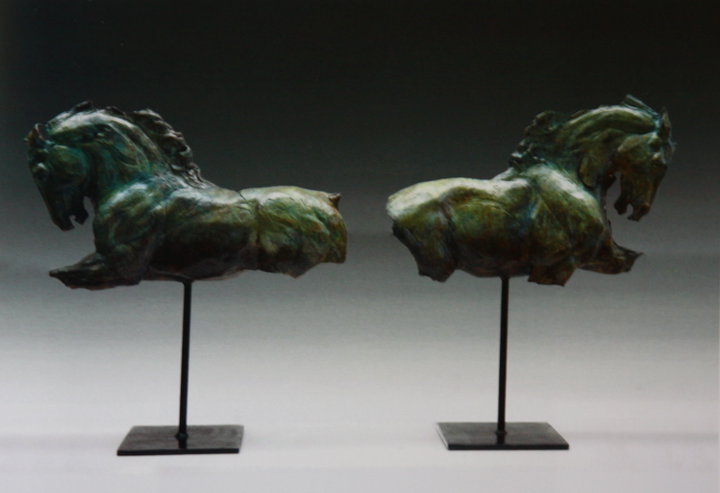
EQUUS FOUND FRAGMENTS I and II - bronze
Lander, WY


Mark Susinno
OVER THE TOP - Oil on Linen
Harrisburg, PA.


Kay Witherspoon
DETERMINATION - Oil on Linen
Englewood, Colorado


Rick Pas
RING NECK II - Acrylic
Lapeer, Mi


HIRAM BLAUVELT MUSEUM ART MUSEUM PURCHASE AWARD
Peter Clinton Gray
GREAT EXPECTATIONS - oil
Cape Town, South Africa


Stephen Quinn
RECLINING BLACK RHINO - bronze
Ridgefield Park, NJ


PATRICIA A. BOTT AWARD FOR CREATIVE EXCELLENCE

Gary Stabb
ATTA - Bronze, Glass, wood
Kearney, Mo


THE EVELYN AND PETER HALLER MEMORIAL AWARD FOR SCULPTURE

Dan Chen
BETWEEN THE RAFTERS - bronze
b. China resides Eugene Oregon


PRESIDENTS AWARD

Jan Martin McGuire
DUST DEVIL - Acrylic on Panel
Bartlesville, Oklahoma

THE LEONARD J. MEISELMAN MEMORIAL AWARD FOR REALISTIC SCULPTURE IN AN ACADEMIC MANNER

Patricia Davis
SUMMER STOCK - bronze
Mancos, Colorado

THE NEWCOMER AWARD FOR A FIRST TIME PARTICIPANT IN THE SAA'S ANNUAL EXHIBITION

Chris McClelland
DUGGA BOY - Graphite and Colored Pencil
Hay, New South Wales


THE ETHOLOGY AWARD FOR THE BEST DEPICITION OF NATURAL BEHAVIOR IN ANY MEDIUM

Linda Besse
BATTLE ROYALE - oil
Mead, WA

SOUTHWEST ARTIST MAGAZINE EDITORS CHOICE

Julie Bell
ALPHA WOLF - Oil on Wood
Allentown, PA.

WESTERN ART COLLECTOR EDITORS CHOICE AWARD

James Coe
WINTER ABSTRACT WITH HERON - Oil on Linen
Hannacroix, NY


(rc)